Monday, April 13, 2020

Why have people been randomly and meaninglessly contacting me lately? It has nothing to do with the CCP virus, I'm sure, and even less about concern, god forbid, since none has been expressed.

The first was my cousin Audrey who, last I heard, was living in Switzerland. I know nothing about what she's doing now and don't even remember the last time we had contact. Our back-and-forth via Facebook Messenger (which is not communication as far as I'm concerned, but just throwaway chat) was: 

I am back to Taiwan now

How was I to reply to that on a throwaway chat forum? "Good for you"? "Good to know"? "So? Why are you telling me?"? Note the absence, what she's not saying. She's not trying to get my interest, she's giving me no real information, she's not asking anything from me, she's not prompting anything, she's just throwing out a raw fact without any indication what she expects in response to that raw fact. If she used proper grammar "back in Taiwan", I could have just assumed she was just visiting, but "back to Taiwan", if that's what she meant, suggests something more permanent. My response couldn't be much more than her message, that would be rude:

Permanently? lol. 14-day quarantine?

Her: 14 days quarantine 

I gave her no more than she gave me, so perhaps it was appropriate for her to throw nothing back at me. At least we had a meeting of the minds. But she didn't even answer my first question. If she's moved back permanently, that's significant to me and I'd inquire further even if getting information from her would be like pulling teeth. If not, messaging me at all was pointless and she just put an exclamation mark on how unimportant we are to each other. It's possible she didn't understand it. Or as evidenced by her response to emails in the past, it's more likely she didn't even read it. Anyway, I decided to give her a little bit more to see if I could prise why she was contacting me:

Well good, most imported cases are coming from Europe, so just do it. If I had a car I'd visit, but no unnecessary travel these days. Epidemics spread when people move. 

Her response finalized this was a meaningless exchange and ended it right there and then:

Yes

Next was an email from a classmate in my first Mandarin class when I came to Taiwan in 2006. We've only had the sparsest of contacts over the years and have no idea about anything about each other. She sent to me and another classmate who still lives in Taipei: How are you both doing? 

What the hell is that? Is that how kids communicate these days? And she's not even a kid, she's a lawyer the last I heard. And what did she expect in response to an email out of nowhere basically saying: 'Tsup, dude?. In polite company, if I'm contacting someone from whom I haven't heard in a long while and wasn't really that close to in the first place (it was a three-month class and she left early to go to law school), you at least include a greeting (Hey guys,) and you ask some directed question to show your interest (how ya'll doin' with the corona virus), and you say something about yourself to give some context and also something to respond to (I just quit my job, I got married, I have cancer, I'm in *city/country*).

An appropriate response to her email I think would've been Could be better or wazzaaaap, like in the old Bud commercials. Actually 'Tsup, dude? would also have worked appropriately as a response. Instead I waited a few days to see if the other person responded and then deleted the email. That was just rude as far as I was concerned. Mind you, the other person on the email, a French guy, I haven't heard from in years, but if it struck my fancy I'd contact him to get a bite to eat, and likewise if he contacted me to meet up I'd respond accordingly. We've had much more substantive contact in the past and nothing has been lost.

The third person contacting me is pretty much as insubstantial but warranted a polite reply. We hung out for just a short time after meeting way back in 2010 before she moved abroad; it was fun, nothing bad happened, we exchanged music collections on hard drive (which I've mentioned has become a bit of a music listening nightmare, but that she even referenced as a prompt for her message, listening to Pearl Jam that I had given her). I never unfriended her on Facebook. We had a short exchange on Messenger but unlike the previous person it was a proper exchange. It was just random and unnecessary. But nice. And keeps her on the radar. I met her through the aforementioned French guy.

Finally, different from the others, my old Mandarin teacher emailed me. We saw each other just about a year ago when my sister-in-law's sister visited Taiwan in that disastrous meet-up. And of course I'll respond favorably to meeting up with her. There's nothing unusual or meaningless about her contacting me. Finally, someone normal. 

Actually in January, I think my old college friend Madoka tried to engage in an email exchange, perhaps trying to revive something of our old connection, but that failed. I tried to respond appropriately to keep it going, but I think there's just something about the way I communicate or what I communicate that kills it for other people. I have no problem taking all the blame for that.

And my sister-in-law sent an email during the Oscars because of the Korean thing (Parasite won best picture) and we shot a few emails back and forth until I think maybe she realized she's only "supposed" to send me two emails per year at six months intervals and me replying around the middle of those six months. That was the pattern I had observed from a few years back. The exchange we were having seemed like what normal email exchanges are like: an email is sent and if it's something interesting you want to respond to, you do. And that keeps going until it plays out. My sense about our exchange was that she realized she maxxed her quota of emailing me and stopped. I didn't think it was done and even started a draft with something that I thought would be interesting to her, but then that was all. I don't expect to hear from her until next year.

Mind you, I'm not complaining at all. I'm just describing my observations. It's sinking in that I'm really not all that likable in any respect, and I'm not trying to be likable or reaching out. My Mandarin teacher even wrote "If you don't mind hanging out with people", indicating that even to her my countenance expresses I don't want to hang out with people. That French guy probably feels the same. I would hang out with them, I just don't communicate that to them, so no fault to them.
WordsCharactersReading time

Saturday, April 04, 2020

I finally bought a face mask. Nobody cared once I started wearing the mask. It's not the kind being rationed and people are lining up for out the doors of national health-affiliated pharmacies when "apps" tell them they're available. Not surgical nor "PPE", but the kind that folk all around Asia wore regularly pre-CCP virus because of pollution that are sold at any convenience store. I figured those all would have been bought up so I didn't even look, but I started spotting them and figured better than nothing and bought one.

Good timing, too, as the government just announced that face masks are now required on all public transportation. It was a bit of a surprise announcement because Taiwan is still not that bad off. As of April 1, face masks were required on the High Speed Rail and the TRA national rail system, but originally the government was considering requiring face masks on all Taipei buses and the MRT on April 9 when it was forecast that Taiwan's supply of face masks would allow for people to buy 9 masks every 14 days.

I'm not sure why they suddenly decided to require face masks on public transpo and pushing "social distancing" more aggressively, but it's not a bad idea. On one hand, I don't think it's necessarily necessary. Our numbers don't really require it. All cases are still being traced and monitored and most are imported cases that are being discovered in quarantine. New domestic cases have mostly been able to be traced to contact with previously identified cases, so the threat of community spread is still low, albeit as present as anywhere in the world.

On the other hand I think it's a good idea just to keep people from getting complacent about Taiwan's success in slowing the spread. I've felt that going out in the past week. We have it under control, the danger is very low, I don't need to worry about it. But measures like this might be a reasonable, psychological way of keeping people vigilant that there's always a danger. I heard that South Korea also had the CCP virus contained early on, but then it took a single person, "patient 31", who belonged to a Christian cult that ignored the threat and precautions and sparked a spread that went out of control and infected thousands. No one can say that can't happen in Taiwan if we let our guard down, not just the government but the people.

Some western reporting on Taiwan's response (slightly outdated in terms of numbers, currently we have 355 cases, 5 deaths and 50 recovered and discharged):


There was also one by the BBC, but no one trusts the BBC (I meant that as a joke based on the satire Broadway show The Producers, but then).

My primary news sources are China in Focus and the far more snarkier and sarcastic China Uncensored. I've been trying to watch NBC Nightly News, but I've found their worldview to be annoyingly micro and emotional, and if that's the kind of news Americans are getting, it's woefully insulated and deflecting from the larger, global view. Yes, stories about the front-line medical health care workers is worthy, but . . . after a while I just find myself forward arrow skipping through most of it. And I'm already streaming at 1.75x speed to save time.

Sunday, March 29, 2020

I was somewhat shocked when I saw the "L"-word in the headline of a local news story, some doctor calling for a total lockdown based on his assessment of how easily Taiwan's medical facilities could be overwhelmed if the CCP virus starts spreading here. My estimate is that's probably 75% irresponsible, alarmist bullshit and 25% legitimate warning for Taiwan to keep an eye on its resources and preparedness and beefing up our weaknesses. Actually, I think we're currently still in a comfortable enough position where I think we would be able to set up a task force just to do that as a smart thing to do (Come on, President Tsai, get with the program*) (edit: The government announced on April 7 that they were doing pretty much exactly this).

Calling for a lockdown is akin to calling for an economic shutdown, and looking at places where lockdowns have been warranted and implemented, their economies are being devastated. True, epidemics spread when people move, but when people stop moving, so does business. I haven't heard of any assessment of Taiwan's economic ability to handle an economic shutdown, but the prospects can't be good. Lockdowns are a last-ditch, desperate measure to fight a manifest threat. They shouldn't be used as a preventative measure when they aren't absolutely necessary. Bills need to be paid, money still needs to be moved, products still need to be consumed.

Currently, business is still going on in Taiwan, albeit not-quite-as-usual. People themselves seem to be refraining from "moving" if they don't need to and I've observed generally less people and traffic about. But people and cars are about and buses still running. Streets, parks and playgrounds aren't deserted. I still think about 60% of people wear masks out in public, and my personal opinion is that fewer actually need to, and "social distancing" isn't a mandate but only practiced when noticed and convenient. Higher mask-wearing percentages are observable on public transportation, work places and service businesses.

The mayors of Taipei and surrounding New Taipei City have both stated that lockdown procedures are coordinated and in place if ordered, although I imagine Taipei's mayor is getting excited in the groinal area at the thought of a lockdown as he's an authoritarian, control-freak moron. It would be the ultimate hard-wank for him to put Taipei on lockdown, but it's good, I suppose, that they have a plan. 

Me? I . . . actually don't know what a lockdown means or how I would be affected. I might be totally screwed. My main concerns are, of course, food and alcohol; being able to get out for food and alcohol and stores being open to get food and alcohol. Hopefully, it would be like the U.S. where essential businesses (including liquor stores!) would be allowed to stay open and I think convenient stores in Taiwan qualify. Hypermarts may qualify, which would be good. OR lockdown can mean more sitting meditation and less of this neurotic scanning the news for updates how things are going. Come to think of it, I should welcome an alcohol supply cutoff. 

* Just a joke. President Tsai's administration has been getting stunningly high approval ratings in regard to handling the CCP virus and mainland China. They didn't always get high ratings as it suffered some hiccups early on, most notably from a progressive, worker-friendly change to labor laws that didn't take into account the far-reaching effects that sent ripples of chaos and uncertainty down the supply chain. Some industries just don't work the way the law demanded, and many of the workers the law was supposed to protect were actually disadvantaged. There was a lot of backtracking (and face-palming) in the wake of that fiasco. 

Monday, March 23, 2020

Skimming the news feed these days is like watching the world burn while Taiwan is still a relatively safe haven where my daily routine has only slightly been inconvenienced. Taiwan has done a great job in slowing the spread of the CCP virus (Chinese Communist Party virus, i.e., the Winnie-the-Pooh* Wuhan Panda virus) and keeping the public safe and informed. It has been efficient and effective in implementing well-reasoned measures that has kept people calm and brought out civic-mindedness that by my measure is already at a pretty high level in society.

First off, Taiwan was extremely quick out of the gate at first hearing of a fast-spreading disease in Wuhan, China. Experts were sent to assess the situation and flights from Wuhan were immediately thermally screened for people with fever or signs of illness. That was being done by the end of December because the current Taiwan government is uniquely tuned into when the CCP is covering something up; whereas much of the world is willing to follow CCP propaganda (hopefully that will change now). At each point in escalation, Taiwan ramped up protective measures. Taiwan already had an emergency response system set up as a result of the SARS epidemic in 2003 which also started in China, and activated it giving us a centralized command post to specifically deal with it. Another unique feature about Taiwan is that the government was able to coordinate the immigration bureau and the national health system to identify who was returning to the country and using the health system. If they had come from China, and increasingly other hot spots, they were checked out.

Taiwan has also been impressive in identifying the sources of who was getting infected and quarantining the people who had been in contact and sending out warnings to people in places where there may have been exposure. For example, an Australian musician had come to Taiwan to perform and after he left he tested positive for the CCP virus. Taiwan traced his flight into the country and sent warnings to the passengers in his immediate vicinity on the flight, quarantined the local musicians and workers who had close contact with him for the concert, sent warnings to people with tickets in the front rows, they determined he had not taken public transportation at anytime and his local driver was identified and quarantined. All of this without scaring the shit out of people and causing a panic. Mind you, I'm just recalling what I read from a news article and not stating it as fact since I can't verify it with multiple sources.

Currently Taiwan still has less than 200 cases, each numbered and most sources identified and whether different contractions were related. Last week I noticed in the news that almost all the new cases were being imported and the next day the government closed the borders to foreigners and ordered all returnees to be quarantined for 14 days. And the quarantines are no joke, at least two people who flouted the quarantine displaying zero regard for the public's health were slapped with the maximum fine of US$33,000. Lesser fines have been levied upon quarantine breakers whose threat was not as egregious. One suspected quarantine breaker was found to have mistakenly given the wrong contact information, but was not fined because the hotel staff where he was staying vouched that he had not left his room. The authorities are being reasonable.

Most recently, the government rejected calls for general testing and responded that our situation didn't warrant it and might even be detrimental because of the high possibility for "false negatives". In South Korea and some places in the U.S. it was done because of how fast it had spread and because it had already reached the level of "community spread". The danger of false negatives was shown in the cruise ships where everyone was tested before the virus manifested, so there were people who tested negative and thought they were clear, but then it turned out they had it and possibly had contributed to spreading it. I'm only guessing here, but it seems our politicians are listening to medical experts and science.

I've been going about my days with heightened diligence as a matter of being civic-minded, but otherwise little is different. There are less people at the libraries which is great, and I get my temperature taken every time I go. At times I notice there are fewer products at the hypermart due to sporadic runs on certain items, but the shelves haven't been cleared since there was a run on toilet paper early on when an advertising agency announced that toilet paper material was being diverted for face masks. The government stepped in and stated toilet paper and face masks were made of different materials and there was no danger of a national toilet paper shortage, and they slapped the agency with a fine for misinformation. It still took several weeks to re-stock and a purchase limit has been imposed. I would have been shit out of luck if toilet paper was made out of alcohol.

I don't wear a mask mostly because it just seems such an inconvenience to buy them. I can always tell when a national health-affiliated pharmacy has them in stock because of the long lines out the door. I ride my bike to get around and the places I eat aren't in high volume areas where there's more chance of spread. I did eat once near Taipei Main Station, still a high volume area relatively, and they took my temperature and sprayed my hands with disinfectant; expected and reasonable precaution. On the streets, probably more than half of people I observe wear masks, but not everyone. On the few times I've taken a bus, 99% wore masks (I was the 1%).

I'm not being cavalier about it, thinking I'm not going to get it. I'm balancing my low-impact lifestyle as a low-impact soul with reasonable actual likelihood that I have it at any given moment and am pre-symptomatic. No one can be 0% positive, but I'm pretty low. Little to no interaction with people, mindful of surface areas I touch (I do carry a bandana and otherwise don't push buttons with my fingertips which are more likely to come in contact with my face), and "social distancing" can be the title of my fucking book! Although the actual title might be, "Yo! Keep the fuck away from me". And that has nothing to do with the CCP virus. I think the highest likelihood of me and transmission is exchanging money.

If I do feel cold symptoms, I'm pretty much screwed. I might consider it a too high a risk to go out, maybe even for food, and of course I have zero social support. I suppose I could use a bandana for a mask, maybe wear gloves although I wouldn't want to advertise that I was unwell, and only go out to get food at nearby convenient stores using my cashless payment card (called "yo-yo card" in Taiwan) so that nothing I touch is touched by someone else.

* CCP Chairman Xi Jinping has been likened to Winnie-the-Pooh which has led to a ban of the cartoon bear's image in China, believe it or not.

Sunday, March 15, 2020

My water went off yesterday afternoon. Annoying and anxiety-inducing; I don't know when it'll come back on. I don't know if the landlord gave warning and I didn't get it because I don't have a phone. The last time it happened about 5 years ago, he knocked on my door and gave me an estimate for the outage so I was able to fill the bathtub beforehand for my water needs. I don't know if he didn't knock on my door this time because my cousin managed at some point to suggest to him that I "didn't want to be bothered", which is totally untrue and would be rude, and I told her to communicate to him that was not the case, but I don't know if she did that. Lots gets lost in translation in this family – and not just in language. 

And somehow, without going into any TMI detail, my gut knew about it and the accompanying inability to flush the toilet more than once, and the chronic issues with my digestive system over the past few years disappeared for the time being. It's a minor miracle maybe. 

So far, it's fair to consider it a minor disturbance and I tried to maintain my evening routine Saturday, but I did opt to not drink until way late. Maybe I didn't want to be distracted from the distraction of not having running water (and perhaps avoiding the need to pee more often). Not washing hands or brushing teeth are something I just had to endure, but not being able to take a shower triggered the neurotic in me. I won't crawl under the covers to sleep if I haven't showered. It's just not comfortable and I knew I wouldn't be able to fall asleep, so I knew I was going to sleep on top of the covers (which is no big deal since that's how I nap) and in that case why bother changing clothes to sleep? No different from crashing at someone's place when I was younger.

I did have trouble sleeping, which I anticipated and didn't set the timer on my CD player, but did slip into sleep at some point and had a pretty disturbing and harrowing dream. I was kidnapped and stabbed twice in the process. This is likely a reflection of my true anxiety about having no water; uncertainty and a hunkering down mentality. The kidnap situation lasted the whole dream through a variety of sundry scenarios including a blood-sport, fight club-ish free-for-all amongst the kidnappees. I mostly laid low and hoped not to be targeted while not expecting to survive. Towards the end of the dream there was rumor that lawyers were being sent for to deal with the situation and I thought, "Lawyers? What good are lawyers? That's even dangerous". At some point I established we were in Thailand as I (irrationally) wondered why kidnappings always happen in Thailand. But the lawyer arrived from England and came up the stairs asking about the "Yank", as in Yankee, as in me, and he took one look at me and continued to ask for the Yank. As he assumed I wasn't the droid American he was looking for, I waited for a few beats to let him hang in ignorance before I voiced up. 

Twenty five years ago that would've been racist. Nowadays it would be called "racist" but would also be stupid to call racist. I'm not gonna get into it, but from what I've witnessed in the progressive political scene from afar, the political left has really dropped the ball and gotten stupid, overreacting to every little thing and just putting people on the defensive instead of trying to educate and promote sensitivity. My dream British lawyer would've been racist before because it was institutionalized with negative assumptions and real effects. Today, the British lawyer should be recognized as having come from a certain background with his own experience that informs his subjective view of the world, and he may make assumptions and even mistakes, such as "American" equals "white" or Asian-looking equals "not American", but that doesn't necessarily make him racist now. Plurality needs to acknowledge that. Constantly putting people on the defensive for infractions they didn't even know of eventually leads to a backlash and them going on the offensive and that's pretty much where we are now; a cycle of brazen stupidity is complete with the true racists coming out the woodwork and proud of it.

And, yes, the lawyer in the dream was white and male. Would anyone imagine otherwise when I said "British lawyer"? Actually my true dream British lawyer would've been South Asian and female, but that's a different kind of dream (mm, that accent). He also had long hair and a ponytail, kinda like that Virgin Branson guy. This is all immaterial, mind you, I didn't need to bring it up but it was in the dream that he assumed I wasn't American and I noticed it. 

What I'm actually seriously curious or concerned about is why mindfulness practice doesn't come up when I'm dreaming? I noticed that afterwards. Is my practice not deep enough to have reached my subconscious? Are my reactions in dreams a more accurate reflection of the success of my practice? I kinda think so, maybe. In a dream, if I'm reacting to the dream situation like it was real, then that may indicate that in physical life I'm reacting to situations too much like they're real. The actual reaction should be appropriate, but in extreme and harrowing situations, I think a conscious acknowledgement of mindfulness practice should be present maybe. 

Saturday, February 29, 2020

On one hand, I play with the possibility that elements in my two previous posts are causal and related. I wrote about something I "shouldn't have" because I don't have a guru and have no idea what I'm talking about, and that could have led to repercussions. Obviously, this is speculation about phenomena not on this physical plane of existence, which would just be plain silly; albeit arguably not too far removed from psychosomatic reactions and phenomena. It's the difference between psychology affecting physical reality vs. spirituality affecting physical reality. We've started to accept the power of psychology on reality; spirituality not quite yet but perhaps in the future when understanding or assumptions are different.

On the other hand, I remind myself that the dharma is fundamentally benign and non-judgmental. Whatever I'm reading into physical reality is my own interpretation and creation and a reflection of my own (spiritual) psychology. There may easily be no actual infractions or repercussions except as tools in furtherance of the primary dharma aim, which is to cut through delusions. The potential problem is attaching to the tools and not realizing they are delusions anew.

There are stories in Vajrayana lore of dakinis or deities appearing to practitioners and scolding them for "doing it wrong" and correcting errors in practice or rituals. They may be just stories to express something about the teachings. To put it in perspective, some hypothetical storyteller or dharma raconteur could look at what I've experienced and subjectively reported in blog and be inspired to re-work it into a story about how so-and-so practitioner arrogantly created bogus meditations without a guru thinking they were methods of cutting through delusion, so some dakini or deity decided to send a warning affliction to . . . whatever; do whatever for whatever purpose. The aim of the teaching would dictate how the story is told. And who knows?, maybe the actual stories that were the sources for the lore were quite mundane. And yet it may still be taught that on other planes or aspects of existence, they are to be taken literally. It might not be either-or how the stories were created and passed down, or even how they're intended to be taught or understood.

From what I've read it appears that a fundamental flaw in my practice is that I don't have a guru, a guide, but that's an intuitive decision I've made for myself. In this lifetime I don't want a teacher, I don't want to look for a teacher, I don't think I could form a relationship with a teacher. Whatever pitfalls I encounter by going it alone I'm willing to accept as part of my path experience. And the universe goes, "Well, OK then". And the fundamental flaw is still there, but also isn't. If that's the decision I made, I shouldn't worry too much about it. I read warnings about dangers, pitfalls, spiritual damage and harm to karma on a subtle level that's hard to repair. But I don't think that's too different from the analogous things on a physical reality level – the things we do in the course of our lives that are harmful on all sorts of levels.

Also from what I've read, intent is of paramount importance in practice. If that's the case (and I have to take it with a grain of salt) I'm good with where I am with intent, acknowledging I still have faults and failings and am no where near perfect in that regard. The part where I have to add seasoning is that I once had an argument in college with a dear friend, Diem, a Vietnamese Buddhist (I wasn't calling myself Buddhist at the time, but the language Buddhism used spoke most clearly to me), over the primacy of intent. She said intent was all that matters, if your intentions are good then you are doing good. That is echoed in some of my recent readings. But for me, I thought that was naive and argued that consequence is also important, if not more important. If you do something with good intentions but fail to consider the consequence and that leads to bad results, you can't say what you did was a good act (that would be delusion). It's an old argument of nuance that was resolved by adding wisdom to intent. Good intent isn't blind, just allowing for feeling good about oneself, but includes and requires wisdom and foresight.

As for why the pain in my lower back, which I expected to go away after 2-3 days, has continued to linger is still a mystery. Is it psychosomatic? Spiritsomatic? At all related? Age related? Am I still missing something I should have learned? That probably goes without saying. The pain certainly has decreased and I'm not impeded in most things. I still can't sneeze, believe it or not. Actually, in the past sneezing has occasionally triggered the pain. My best guess is that sneezing requires healthy lower back muscles, and the way mine are now, whenever I start or want to sneeze my lower back goes, "Nope, not gonna happen" and the sneeze dissipates unrequited, disappointed, unsatisfied *sigh*. Maybe a good thing these days since if you sneeze or cough in public, people look at you to see if you look sick and might have the Xi Jinping Wuhan Panda virus.

Saturday, February 22, 2020

Interesting. There is a topic of personal belief I have about Vajrayana practice, a theory actually, which is that this sort of practice, in my case merely inspired by Vajrayana but still applies, requires or involves a heightened sense of responsibility, levity or vigilance; what I've perhaps suggested as the dangers of not having the guidance and security of a guru or teacher. 

It's not a fully formed theory and I had no idea how to approach it. Basically, any sort of practice even hinting or striving for the Vajrayana level is not a laissez-faire spirituality. Personal doubt must remain high and real repercussions should be expected in case of infractions or violations. In the abstract, any idea of disrespect towards the dakini, or feminine principle, or what any human woman potentially represents, is a no-no. Just don't do it or catch yourself and stop. Obviously that's a less of an issue for female practitioners, albeit with qualifications. It's just an example.

Slightly less abstract would be something like losing one's temper. Any approach to Vajrayana practice assumes a certain level of self-control developed through ordinary mindfulness practice supported by daily sitting. Losing one's temper is not just getting angry, which is part of human experience even in Vajrayana practitioners, but it's negative energy unleashed and lashing out, getting out of control. It doesn't have to be directed at or witnessed by another person. It could happen in oneself even alone and there theoretically can be damage done and repercussions, possibly in the form of health problems or instant negative karma that brings about negative, harmful views, perceptions or even actual incidences that might not seem related, but are. Of course, there's the argument that losing one's temper does just as much damage in a non-practitioner, but there's a higher degree of awareness and responsibility of an infraction in a practitioner.

I wasn't sure about publishing my previous post. There seemed to be a risk in exposing or describing aspects of my not-Vajrayana, Vajrayana-inspired practice that I really have no idea what I'm talking about. Then promptly after posting that, I went into an unidentifiable, physiologically ambiguous physical decline (if I had more contact with people I might have suspected the Xi Jinping Wuhan Panda virus that is all the rage in global epidemic circles) that culminated in debilitating lower back pain. 

I'm no stranger to this lower back pain, it's chronic and I've experienced it sporadically for many years. But usually I feel it triggered, I feel the twinge and know right it away it ain't good and spend the next day or so with a heating pad, Advil and Salonpas menthol patches which I always have in my apartment. I'm dealing with this the same way. I'm expecting it to go away as usual, but this does feel a little different, particularly debilitated, like it has something to do with that post. Energy repercussions. A teaching maybe. 

I mentioned physical discomfort and strife and mental struggles like they were big deals, and there's no problem with that from a personal perception view. We feel what we do and if we feel it as shit, we describe it as shit. But this lower back pain puts those physical problems in the realm of annoyances and inconvenience. They weren't "I can't get up", "I can't go out" constant, excruciating pain problems. And this kind of physical pain overrides and overwhelms any perceived "mental struggles or challenges". I'm not dealing with those when I'm mentally struggling to even sit up or lie down or change clothes or put on shoes!

And debilitating lower back pain?! What if the mandala world decides to send me cancer, or a car to hit me and send me to the hospital or a major earthquake? "I can't get up/I can't get out constant, excruciating pain"? Something can always come up and put that into perspective as nothing, preferable even. But this is my Vajrayana-inspired practice, so yes, it becomes a teaching. I don't mean this as a gloom and doom, it-can-always-be-worse-and-eventually-will-be post, but more of a mindfulness, preparedness post, because the opposite side of the same coin encourages positive mindsets and their power and appreciation for things as they are.

Tuesday, February 18, 2020

It's been about two and a half years since I had a personal landmark realization. I wrote about it at the time, but I don't think I made much of it because despite being a landmark personal realization, it also didn't seem to be a very big deal. Part of it was OK'ing for myself to just maintain my lazy status quo; no dramatics. Key ideas were about the conveyor belt of routine getting me from day to day, accepting that alcoholism was not going to kill me and cutting back as a result (somewhat), and "looming" as a requirement for getting on with my life and/or death.

Looking back, it indeed was a landmark realization that has conditioned the way I've been living my life and applying my Vajrayana-inspired practice, and it has been personally certifiable as transformative. There were struggles, successes, failures – all internal space, mind you. Swamped in karmic negativity, there was a lot of qualified positive that came out of it. 

Two and a half years that went by just like *that*; not unlike how many of the years prior in the past decade also went by just like *that*, basically biding my time, wasting my life by normative measures of the value of our lives. I don't regret any of it, mind you, as I'm not the regretting kind and I don't give a rat's ass about other people's standards. 

I'm quite happy not to be involved or entangled in anything, and I'm grateful beyond words that I haven't taken the path of relationships or, god forbid, marriage and family. My life has become just about keeping things simple, not getting involved, and just dealing with my own issues. My view of the way so many people live their lives is that they thrive on mess and complication and wouldn't know what to do without it to the point it's not only normal, but almost desirable because the mess and complication is so integrated to the pursuits of their desire. And then they still have to deal with their own issues amidst that tumult! Braver souls than I, indeed, but it's just my projection and most likely doesn't describe how they view their lives. Fine :p

My well-being and health aren't really considerations, they shouldn't be considerations when dying and/or suicide is the goal, although I've still found myself caught up in trying not to feel awful physically and avoiding discomfort. That's an attachment I haven't let go of. Dedicated seekers on the path have. On the other hand, feeling awful and physical discomfort is inevitable as a human being and I have employed Vajrayana-inspired practices when they occur. 

Instead of feeling miserable and accepting the feeling as miserable as fact and suffering as a result, investigating the sensation and the judgment involved in its "miserableness", its miserable nature. There's the sensation. I want to call it miserable. Do I really need to suffer because of it? Expanding Vajrayana-inspired mental "Buddha-fields" to understand this is all practice and my mental attitude is a reflection of how well I'm understanding "the result" aspect of practice. If I'm suffering and feeling I'm suffering and define it as suffering, then the result is that I'm suffering. If I experience physical misery but establish the result is that this is a natural condition of being human and how I live my life and treat my body, then a higher level of acceptance is possible and it's not so much an affliction to suffer but an understanding of the natural course of things. 

The mental stuff I've found is easier (who said that? did I just say that?). And I attribute this to years and years of sitting meditation and mindfulness practice. I don't think it's something you can just tell yourself "it's all mental" and write it off. But that might be what it looks like in describing it. Feelings of sadness, melancholy, depression, even waves of them. I get them in their gripping reality, they come up and mindfulness practice looks at them and goes, "what the hell you doing here?". 

I attribute much of this, perhaps, to insight into teachings on the enlightened nature of all things; the enlightened nature of mind, both the subjective perceiving/processing mind and the objective mind projected in what is perceived by our senses. It's taught over and over again in all schools of Buddhism that our nature is inherently enlightened to the point that it's intellectually meaningless (like many things zen), and requires a non-intellectual realization to push through its meaning (including/especially in zen). And once you do, a lot of the mental stuff doesn't make any sense treating it as what it seems like. 

We treat sadness, melancholy and depression as negative things that are undesirable, but that doesn't square with insight into the enlightened nature of reality and all things. To square it requires realizing those undesirable things are still a part of enlightened nature. It's the result-orientation of Mahamudra practice (as opposed to path-orientation of other approaches like zen, none of which are right or wrong; different tools for different people). Sadness, melancholy and depression are all enlightened expression when you don't attach to those concepts being what they seem to be. 

Great! Fine! Faboo! What about "looming"? I don't know. I don't know if I'm facing a reckoning in 2020 or if nothing's going to change despite the perpetual feeling that something has to. I've recently been taking to heart the saying "If you're going through tough times, keep going". Keep going and you will get through it. Just keep going. But then what awaits having gotten through it? The saying assumes an end of the tough times. For me, "getting through it" means being able to end all of this. And it's not end of tough times because of ending it all, it's a positive ending it all because of understanding and fulfillment.

I may be facing a financial reckoning, or looming, with just a few months into summer left of finances if I don't do anything. I got sick of those monetary injections into my bank account. I was begrudgingly willing as long as there were no problems, but the last attempted injection didn't go through, and I'm so sick of it that I'm unwilling to investigate why. If that didn't go through, there's no reason to believe any other will, so just stop. They were humiliating in themselves, but looking into why it didn't go through becomes desperation and defines desire to live. This is a terrible, horrible, insensitive analogy, but it's like I have cancer of the life and those monetary injections were the chemo keeping me alive. But I've gotten to the point I'm unwilling to go through it anymore. If the chemo isn't working, why keep going through with it? It's a terrible analogy, but it's my mindset.

I think I'll also attribute to mindfulness practice that this looming isn't sending me into a mental tailspin as it did before. May the Buddha-fields, the mandalas, be evermore encompassing.

Sunday, January 26, 2020

It's the third day of the Lunar New Year that I've spent in a wonderful solitude. With everyone else living on this floor gone, I've felt a bit more like a hermit. Even though I usually avoid contact with them and have no idea what they even look like, I'm always aware of them when they're around as I can hear their comings and goings. The first three days are the official holiday, and days four to six are when things start getting back to normal. It's possible everyone will remain gone until Wednesday, it's possible they might start floating back tomorrow. I'll know when they return because I will hear them.

My mother was in town last weekend for several days. She had been on a cruise, disembarking in Singapore, and flew to Taipei for a few days before flying back to the U.S. My uncle came up from Kaohsiung to spend time with her. I think his thinking may have been that they're getting old, no one knows when will be the last time they see each other, so take advantage of every opportunity to meet up. Neither of them I figure for being sentimental types, but it's possible. I don't know him that well really. She's definitely not. She said she came to see me, but the truth is we can only stand each other for a few hours at a time so maybe she did ask him to come up. She still thinks I'm working so I always have an excuse to bail, and true to her own work ethic, she would never prioritize herself over someone else's job.

On her last day here (she was flying out in the afternoon), she expected to meet up with me at lunch and initially said that my uncle wouldn't be with us because his son, my cousin Gary, was flying in that morning from mainland China for Lunar New Year and so he would meet up with him and they'd go directly to Kaohsiung by HSR. I had to brace for one more excruciating lunch without his buffer. 

But then prior to that, I realized that didn't make sense. Gary was flying into the airport that my mother was flying out of later that day and they weren't going to meet up? My mother doesn't give a rat's ass – not the sentimental type, I said – but Gary has something like an overblown sense of responsibility and family decorum almost to a fault. In his mind, if there was a chance to meet his aunt (who sat at the table of honor at his wedding), even if only for a few hours, he was going to make it happen. Turns out I was right and when I arrived at the hotel, my uncle was still there and Gary and his 10 year old son were on their way from the airport by MRT to Taipei for us to have lunch before they departed for Kaohsiung, my mother to the airport, and me . . . to "work", of course. I didn't even have time to accompany them to the airport.

There was some discomfort as to why I wasn't going to Kaohsiung for New Years until I came up with the excuse that I had already volunteered to work over the holiday since I was basically a foreigner and the Lunar New Year didn't mean as much to me. I'm a terrible liar, and of course when you start lying you have to back it up, and I hadn't prepped myself for Gary (whose English is decent) to get inquisitive about my job and my having to make things up on the spot, particularly difficult since The China Post went under as a physical paper many years ago (it may still be online, but if it is it's no longer a major news player in Taiwan).  

But there really was no way I would go to Kaohsiung for the holiday. As has happened before, whenever I'm placed in an extended family setting I have to keep my mouth shut. If I selfishly open my mouth to say something, whatever conversation had been going on had to stop and focus on me, the only English-only speaker. I prefer to consider myself persona non grata. I haven't heard from Gary's sister, Audrey, any time recently. I have no idea where she lives now nor whether she's flying in for the New Year, and if she has no expectation of meeting up with me, then really no one does or even should. 

As far as family is concerned, all is as should be. My sister-in-law and I used to email each other twice a year but she didn't at all last year. Doesn't mean she won't, but I ain't expecting anything. I did send that birthday greeting to my brother in July and he responded, but proper form between us meant that was all – greeting and response, it wasn't supposed to be a communication or continued exchange. 

Sometimes I think I just have to face that these people just don't like me, lol! And there's no reason for them to like me, I give them no reason to think I want them to like me. Theoretically I know I can contact anyone at any time about whatever, but my principle of don't be something to someone and then disappear prevents, since my disappearing is always an option or an intention, even if not likely or immediately manifesting. What's their excuse for not contacting me? Maybe I'm lacking in imagination, but the foremost reason is they don't wanna because they just don't like me, lol! Why would you contact someone you don't like? Why wouldn't you contact someone you like and haven't heard from in years?

I know relationships are complicated and this line of thinking is totally faulty. I have friends I've been out of contact for years and nothing is preventing me from saying 'hi', but I don't. Saying 'hi' isn't being something to someone, it's just saying 'hi'. I can say 'hi' and kill myself the next day and it would just be what it would be. No different with family. You just expect them to be there merrily rolling along. No one knows when will be the last time they see each other, so there's no reason to think there won't be a next time.

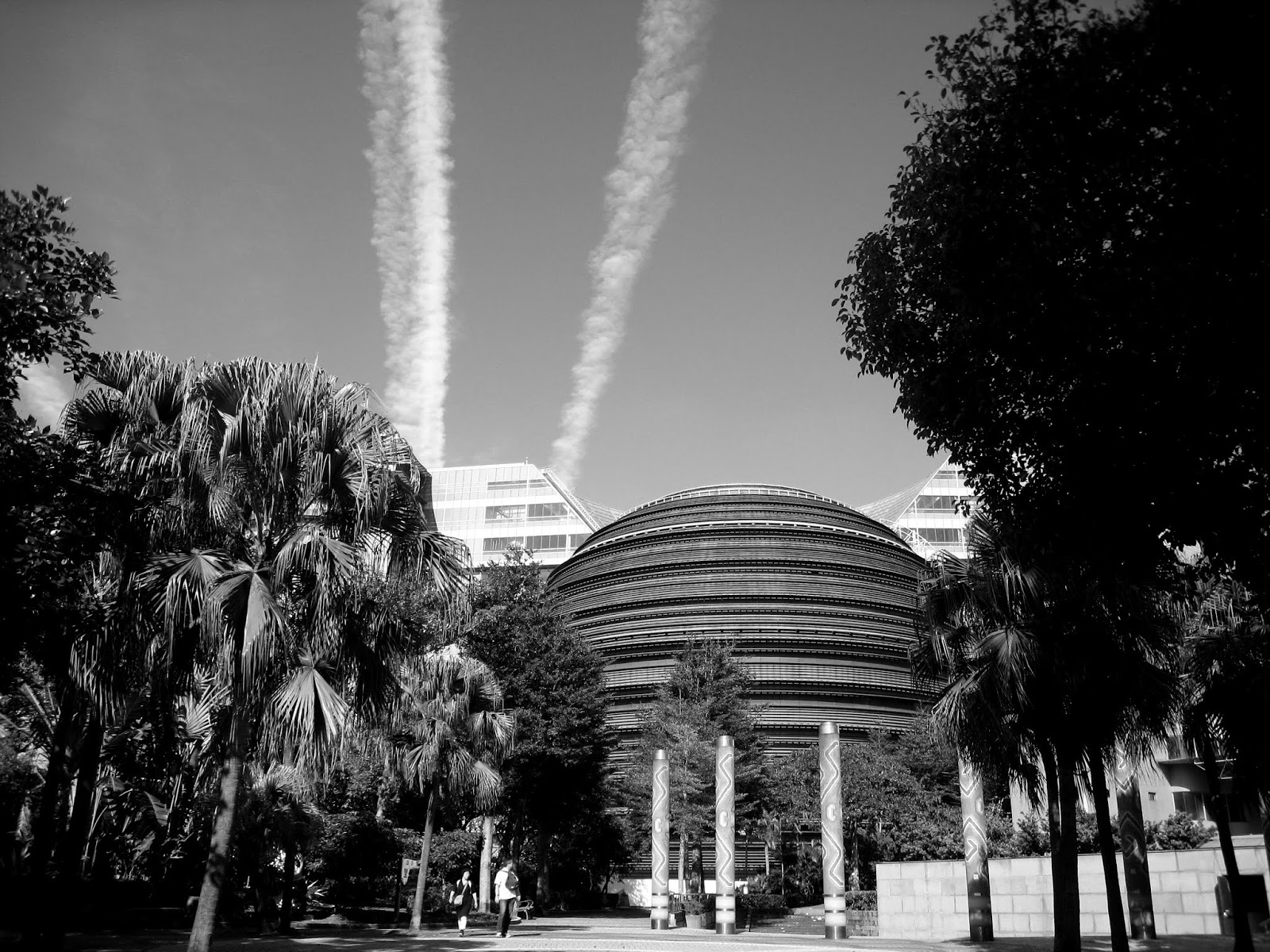
MONDAY, DECEMBER 2, 2019,1:54 p.m. - They day I found out The Living Mall had died closed.
MONDAY, DECEMBER 23, 2019, 3:13 p.m. - Sanmin Branch Taipei Public Library, 6th fl. photostitch.
SATURDAY, DECEMBER 28, 2019, 3:03 p.m. - Through a window on a side street.
3:23 p.m. - The dead Living Mall from the southeast side, access fenced up. It kinda resembles the Jawa sandcrawlers on this side. Total coincident that the sphere on the other side looks like the Death Star.
MONDAY, DECEMBER 30, 2019, 2:55 p.m. - Temple on Ba De Rd.
SATURDAY, JANUARY 4, 1:43 p.m. - And all the crap on the plaza outside The Living Mall that obscured appreciation of the architecture.

Monday, January 13, 2020

In the batch of photos I posted last month, I mused that some shots would've been better in black & white. Black & white is my preferred medium, and it was easy when all I had to do was slap a roll of black & white film into a camera. With digital, the default is color and I don't have the talent or skill to use the "black & white mode" and have things come out satisfactorily or even workable in post-production. The reason behind those shots is that I was just shooting how I always did, looking at form and composition and not thinking how color might make them mundane and pedestrian. Adding that color dimension back to reality and it's one dimension back to ordinary. 

But that got me thinking and recalling hearing that for digital black & white, it's better to shoot in color, emphatically not in the camera's black & white mode, and remove the color in post. I was always closed-minded about that, feeling that if I was shooting in color, I was seeing and thinking in color. That's not black & white! Closed-minded, I tell you.

But for December, I thought why not at least give it a shot? Shoot with my little digital point and shoot with the intent that the final image will be black & white. I'm still figuring out the best way to remove color and choosing which method I like best. As a baseline, I use GIMP's basic desaturate function and then adjust contrast and brightness, which is standard for me. I'm experimenting with another function in GIMP called "mono mixer" which removes the color, but then you can adjust red, blue and green values as represented in black & white tonalities. I currently have no idea what I'm doing with that, I'm pretty much floundering haphazardly hoping for serendipity. The color controls don't work like filters do with black & white, and I haven't figured out the logic in adjusting them. I don't know if one adjustment for one color may be cancelling out another adjustment I did with another. As for results, sometimes I like the straight desaturation, sometimes I like the mono mixed version; so far almost 50-50. I have no idea what I'm doing with green in mono mixer, but in general I like the tonality of foliage I get when using mono mixer. But that doesn't mean anything because I simply have no idea what I'm doing.

MONDAY, DECEMBER 2, 1:52 p.m. - The Living Mall died at the end of November. Those cars at the base of the sphere don't belong there and probably belong to workers or owners orchestrating removal of remaining contents.
MONDAY, DECEMBER 9, 1:45 p.m. - The (dead) Living Mall from the other side. The sidewalks surrounding the mall have all been fenced up.
2:33 p.m. - Across Civic Blvd. from The Living Mall is the Taiwan Railways workshop. It's no longer functional and I think they're trying to turn it into a museum/park. If the timing fell into place, The Living Mall could have survived by integrating this entire area into something like Huashan 1914 Cultural Park. The railway workshop is adjacent to Songshan Eslite Spectrum (behind me) and the refurbished grounds of a tobacco factory transformed into a cultural/creative arts center. A footbridge should have connected The Living Mall with the cultural park over Civic Blvd., and the trees outside The Living Mall should've been removed creating an open plaza that would allow proper appreciation for the architecture (which the footbridge also would've done). There was a lot of "wow" potential in this area. I'm sure timing was the least of why it couldn't happen.
4:10 p.m. - Holiday spirit, Songshan Eslite Spectrum. Buildings of the former tobacco factory-now-arts center in the background.
4:15 p.m. - Meeting up. I shot a series so I know they were meeting up.
SUNDAY, DECEMBER 15, 2:25 p.m. - Taiwan supports Hong Kong against Mainland China's Communist Party, Keelung riverside bikeway. 
2:37 p.m. - The new park I discovered last month along the Keelung River.
3:10 p.m. - A mall/business complex across from Nangang Software Park MRT station on the brown line. Personally I'm not very impressed by it because of the confusing floor plan (effects of aging, no doubt) and it doesn't even seem to have a proper name to refer it by. Still it seems to be fairly popular on weekends, more so than The Living Mall was in the past however many years. 
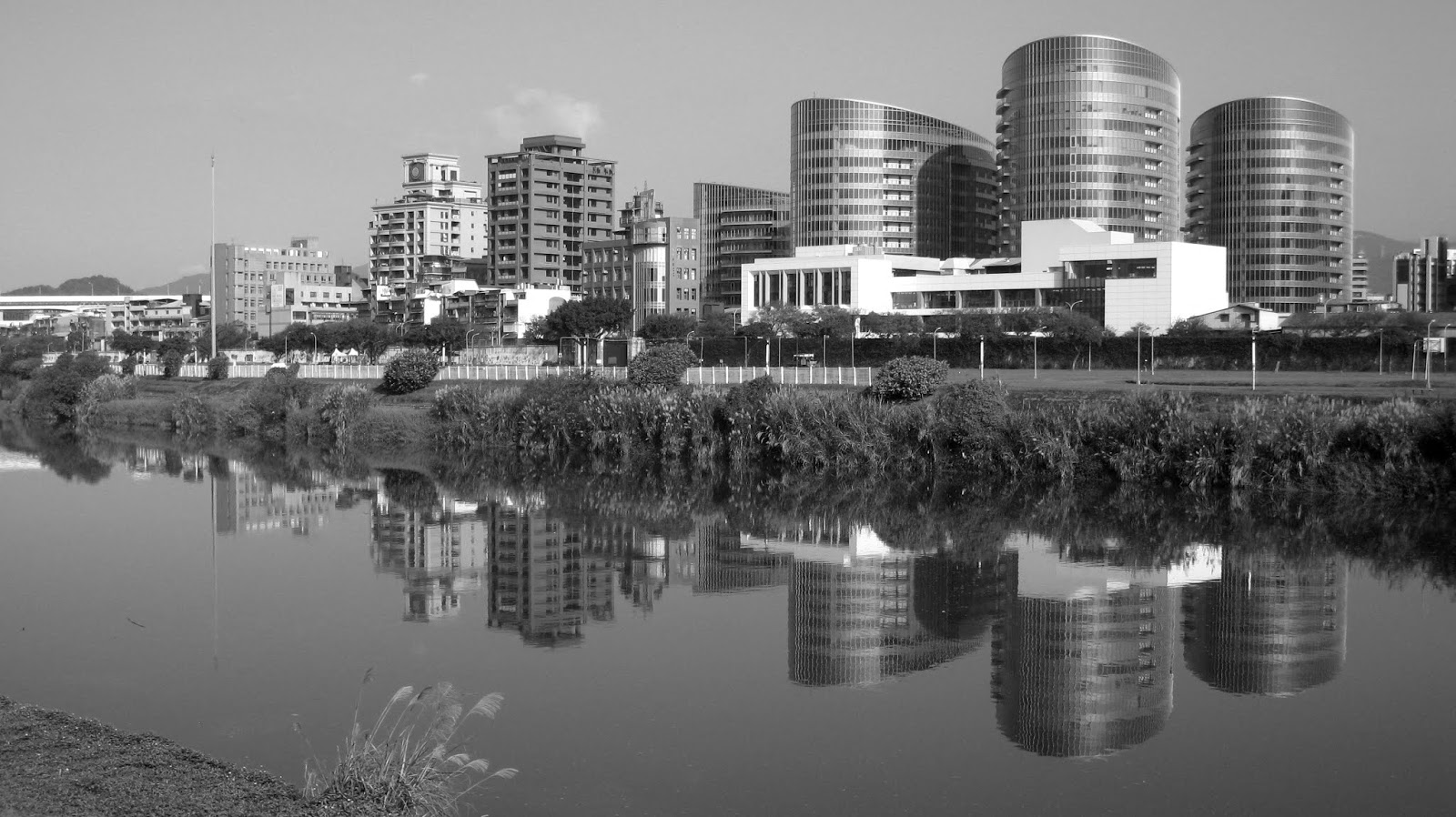
MONDAY, DECEMBER 16, 2:17 p.m. - Keelung River. This was pretty in color (as was the previous pic), but this is what black & white was about for me. It doesn't matter if it's pretty in color, if I'm committed to black & white, I'm sticking to the black & white version. With film I never thought 'oh this would've been pretty in color'.
2:18 p.m. - Actually two bridges in this shot. Chenggong Bridge with the supports in the river and Huandong Expressway with the arches.
MONDAY, DECEMBER 23, 3:24 p.m. - Sixth floor, Taipei Public Library, Sanmin branch.
WEDNESDAY, DECEMBER 25, 2:27 p.m - Yanshou Park No. 3, across from Taipei Public Library, Minsheng branch.
THURSDAY, DECEMBER 26, 3:33 p.m. - Just architecture of unusual character (AOUC) amidst Taipei's endless, monotonous sprawl of unexceptional low-rises (one of which I live in).

Monday, January 06, 2020

Things have been unsettled lately. Hairy, even. All internal, mental space. Externally little has changed, same as it ever was; sometimes the external acts up and is annoying or my body reminds me about aging, other times it's calm and behaves but it's a comfort that I know can only be temporary. It's the uncertainty and anxiety when the feeling arises that something has to happen, something has to change. I don't know if anything's going to change, despite the press that something is looming. The comfortable pattern has been that nothing changes, but the reality I'm well aware of is that's impossible to continue in perpetuity. These disturbances, I should note, are also a part of the repeating pattern, lulling me into thinking things'll be alright. And they will be alright. Until they're not.

The internal space has been characterized by turmoil, dynamic and surreal. I've been trying to deal with it by bringing everything back to practice; mindfulness practice as well as Vajrayana-inspired practices that I've developed from instinct, what resonates and makes sense to me. Part of the turmoil is that in the background is a doubt about it, what if it doesn't describe a reality of life and death? And it doesn't. Or at least that's totally the wrong question or approach. The only certainty is death itself. The only question is my attitude towards it and how I'm existing approaching it whenever and however it comes.

So many practices that without a teacher sanctioning them, I know I may be running risks. Or not. What risks? I imagine they would be risks on such a subtle level (karma or energy) I wouldn't even know about them. On a mundane, this-world level I'm not too concerned about risks. Those would be risks of harming myself or other people or psychological or spiritual damage. I'm not worried about those, the normative narratives that define those concerns just don't apply anymore. Take psychology, if I spoke with a psychiatrist, we wouldn't even be speaking the same language. I mean I'd find an English-speaking one in Taiwan, but the assumptions would all be completely different. I may say I'm suicidal, but there is no concept of harming myself anymore. The psychiatrist would write a prescription for antidepressants (which I've always thought would be convenient to overdose on). Harming other people is necessarily a this-world consideration, but I've done all I can to minimize that. Any harm I cause would be indirect and more about them than me, and I don't know who "them" are anyway. Who am I causing harm? Who's here?

Mandala practice, dakini practice, bardo practice. Practices that are not practices because they are not sanctioned and therefore considered risky. Considered risky by whom? Of course there's only me, but my doubts in calling them risky are also my fail-safe. Can't be arrogant or self-assured about them. Always leave room for just being plain wrong.

Apparently "bardo practice" is a real thing, and what I'm doing is not it, but very strangely when I read about the real thing, it reminded me of a "winter term" project I did way back in college. Despite all the reading I've done about Tibetan Buddhism and the so-called Tibetan Book of the Dead, I only came across a description of a "bardo retreat" in relatively recent years in a book by Reginald Ray called Secret of the Vajra World. It's described as a retreat that was done in confined cells or mountain caves of Tibet and considered very advanced and even "dangerous". It's done in complete darkness and effectively complete solitude over a number of weeks. The retreat is supposed to help get an experience of the after-death bardo states and the instructions received for the retreat is essentially the Tibetan Book of the Dead.

At Oberlin, we had a "winter term" which was the month of January between fall and spring semesters where students could do anything they wanted and get credit for it as long as they framed it in terms of a project and got a faculty member to sign off on it as academically valuable. As one faculty member described it, you could raise a cactus and get credit as long as you designed it as a project.

My idea for my first winter term started with "solitary confinement". Mind you, this is so way back far in my past I have no idea about the motivation behind it nor the psychology that certainly was at play. I'm just describing how I remember it. I lived in a dorm which had a wing of apartments that were intended for guest stays by short-term faculty. I discovered that one was vacant and asked if I could use it for a winter term project. The idea was to hole myself not just in the apartment, but in the bathroom, which had a bathtub, of the apartment for winter term. Ideally complete isolation, no lights, no books, no music, no external distractions. The curtains of the apartment would be drawn so light couldn't seep in. I arranged for a friend to bring me easy-to-prepare light meals three times a day, emphasis on the easy as I didn't want to be a burden, but mind you hermits and retreatants in mountain caves in Tibet often had benefactors or supporters with arrangements for supplies.

How to get a faculty member to sign off on it? Well, I was considering being an East Asian Studies major and had taken classes to that effect, and in one Japanese history class the concept of "wabi/sabi" was introduced. That concept was expounded upon much later in a "King of the Hill" episode, so I'm going to assume everyone knows about it without my explaining it. But I went to that professor, a most illustrious and revered Ronald DiCenzo (RIP), and proposed my winter term project as exploring the wabi/sabi concept as "Beauty in Isolation". He bought it, god bless his heart, and signed off on it. Some lucky cactus got a reprieve from being raised by my lack of green thumb.

Actual extant memories: I forget if the project was three weeks or four weeks, but I made it for most part until the last week. In that time I stayed in the bathroom, mostly lying in the bathtub with the lights off. I only opened the door to take in the plate of prepared vegetables and leave it out. It wasn't complete isolation as I could still tell day from night since it was impossible for the bathroom to be completely light-proof, and I could still feel and hear activity because this was still in a dorm on a college campus. In the last week, I ventured out into the apartment. That's all I remember. I spent time outside the bathroom in the last week. The only actual memory of the weeks inside the bathroom was singing through the entire double album of Genesis' "The Lamb Lies Down on Broadway", just because I could. I knew all the lyrics (but if I forgot any I had all the time in the world to recall them). And it was confirmed later by dorm residents telling me they could hear me warbling through the vents like a ghost (you can only imagine my embarrassment)! Was I going slightly mad in there? It's hard to argue otherwise.

Reading about the actual existence of a "bardo retreat" and relating it to that winter term project made me wonder where the hell did that idea come from? Could it be from past life resonances whereby I had undergone those bardo retreats? Another brick in the wall of evidence that reincarnation is a thing?

Back to present tension, what I'm calling "bardo practice" now has more to do with envisioning present life and reality as a bardo, equivalent in reality as the death bardos. The death bardos are described in the Tibetan Book of the Dead, and practicing living as if in a bardo state is treating it in the same way. In living reality, I'm being buffeted uncontrollably by the winds of reality like a bird in a gale. I seem to feel I'm in control of myself, that I make decisions of what to do at any given moment, but that's just illusion and delusion of being swept through the dire straits of the walk of living bardo. I'm actually in no more control of my fate, direction and destiny as I envision I would be as described in the death bardos.

In ways it's an extension of what I described before as my version of what I call "mandala practice". Both emerging more prominently in times of internal tumult and disturbance, working to melt away the habit of perceiving reality as concrete and actual. Even when we're able to accept and embrace the teachings of impermanence and the constantly changing nature of our lives, I think we still tend to treat that impermanent and constantly changing nature of our lives as reality, as actual. Somewhere along the line I got it in my head from the teachings that it all has to melt away, the experience of enlightenment is an experience of non-duality, no difference between this ego-conceived concept of me who is here and everything else sensed and perceived around me. It can't be striven for so I'm not striving for it, but I hope to work around the edges and challenging my perceived notions and concepts of reality. The easy targets are negativity and dysfunction and the effects of self-imposed isolation.

Monday, December 09, 2019

So yea, I've been slipping my 10+ year-old 8 megapixel (huge when I bought it) Canon point-and-shoot into a backpack pocket and taking pics when fancy strikes. I'm not doing anything by doing it. It might be something like a last hurrah, similar with music and playing bass along with K-pop tunes for ear-training less than 2 hours everyday for the past two years, revisiting it as something I "used to do" while letting go any idea of it as a part of any identity. It's just something familiar and not a function of ego and as soon as it's not fun, I'll stop.

I've also found myself perusing photography books in the libraries and bookstores. Not sure why, perhaps for inspiration for what I'm not doing, but also investigating what it was and why it once was something I did. I discovered several photographers that I'd never heard of, despite them being apparently famous. I'm also fascinated by the text and commentary accompanying these books as they look into the psychology and character traits of the photographers, suggested by their photographs. Stuff that I recognize in myself or not, stuff that I agree with or not, but agreement or not it's all out there and valid or not. Quite frustrating, actually.

I guess the bottom line for me is that it's just personal, like this blog, and not for anyone else. It's just what I'm finding out about myself. 

Ansel Adams writes in his autobiography: Photographers who frequently travel photograph with less than full knowledge of their subjects. I believe one must live in a region for a considerable time and absorb its character and spirit before the work can truly reflect the experience of the place. In my own case, hasty visits have usually resulted in inconsequential images; perhaps an occasional flash of insight, or a remembrance of an earlier place or time helped in visualizing a photograph. 


Me, I've lived in Taiwan for over 13 years and I haven't absorbed the character and spirit of this place. I lived in San Francisco 11 years and didn't absorb the character and spirit of the place. So what is he talking about? That was it for him, that was important to him. Me, not so much. I'm a permanent outsider and I shoot as an outsider, never absorbing the character and spirit of a place. I actually identify more as an exile.

Or not (Josef Koudelka became an exile from his native Czechoslovakia a few years after the Soviet invasion in 1968):


"I didn't want to have what people call a 'home.' I didn't want to have the desire to return somewhere, I needed to know that nothing was waiting for me anywhere, that the place I was supposed to be was where I was at the moment. I once met a great guy, a Yugoslavian gypsy. We became friends. One day he told me, 'Josef, you've traveled for so many years, never stopped; you've seen lots of people and countries, all sorts of places. Tell me which place is the best. Where would you like to stay?' I didn't say anything. Just as I was about to leave, he asked again. I didn't want to answer him, but he kept on insisting. Finally he said, 'You know, I've figured it out! You don't want to answer because you still haven't found the best place. You travel because you're still trying to find it.' 'My friend,' I replied, 'you've got it all wrong. I'm desperately trying not to find that place.'"

If I posit myself as an urban hermit, I pale to his example. I'm stuck in neurotic, useless routines and my "best place" is my apartment where I'm meaninglessly complacently doing nothing for nobody, and which becomes a prison or a deeply egoistic sanctuary. There's no hint that he'd read even a word of Buddhism or Zen or enlightenment, but he was kinda living that path. Of course I don't know what drove him, but for my purposes I wish I could be like that.

Garry Winogrand was similarly an enigma:


. . . preferring to spend another day shooting rather than processing his film or editing his pictures. No prints existed of many of the best photographs he made in his first decades, and he left behind over sixty-five hundred rolls of film from his later years that he had never processed, or that he processed but never proofed, and whose content he had therefore never seen . . . and though his negatives and proof sheets . . . were numbered, there was no indication where one year ended and another began or where in the world Winogrand was when he exposed any given roll of film. 

That leaves me aghast 😱, as I'm the complete opposite with all my proof sheets and files meticulously numbered and dated. Is that a reflection of ego? Was his M.O. a function of non-ego? Not necessarily, probably not, who knows? But he was a photographer who didn't seem particularly interested in the photo. Was it that he was more interested in the process rather than the result? Was it not even that but the energy of being on the city streets and the flow of humanity and snapping photos in some ineffable effort to capture or see things that are otherwise fleeting and unnoticed?

To be sure, I couldn't shoot like he did, getting in close and shooting without permission or respect even. I recently watched a YouTube video of a Hong Kong/Londoner (his accent sounds too British to be Hong Kong British English) named Kai who was shooting like that in Taiwan and it just seemed rude and disrespectful, often confirmed by the videoed subjects' alarmed reactions. I'm not criticizing it, and the photos themselves were quite good. They did what they did to get their shots, I'm just unwilling to go there and would therefore never get those kinds of shots. 

Back to Winogrand, Ansel Adams, an early advocate (and perhaps paragon) of photography as fine art, would never entrust someone else to print his negatives without meticulous instruction on how he wanted it. That's another school of thought, where the artist's vision is emphasized. There's no art in shooting and then leaving printing or editing, which to Adams is interpretation, to someone else. There's also nothing wrong with that, either. Frustrating, see.


I found a Pablo Ortiz Monasterio monograph in the library that I think is a limited edition. It was printed on a specially selected Japanese paper that Ansel Adams would've appreciated. Adams was also concerned about reproductions of his work and that they reflected the quality of his original prints as much as possible.

Needless to say, all of these monographs are incredible and thought-provoking. There is a ridiculously broad range of even just street photography that is legitimate and valid, despite conflicts and contradictions and arguments for or against whatever. Like for me, context is important. Photography involves a mix of abstraction and reality. The image is actually quite abstract, which is why I always flipped black & white images unless there were words prominent that would call attention to that fact. There's the confinement of the frame, there's the loss of the depth dimension, there's the loss of color, and flipping the image was one more degree of abstracting the image; another way of saying what I saw didn't look like this at all. Context emphasizes the reality; this happened at an identifiable location, facing a certain direction with elements that were observable in the real world. Others may hate that and want to just appreciate the image on its own if it's worth it. It's like songwriters who never say what a song is about because once they do, that meaning is frozen and no one else can interpret it and give it meaning for themselves. Fair 'nuff, but out of all the descriptions, analyses and critiques of photos and photography, ain't nothin' gonna stop people shooting the way they do.

I'm under the description of photographers who try to be anonymous and discrete. Composition is important, but sometimes varying degrees of speed and spontaneity are necessary. If people are in the shot, their attention is not drawn to that fact. I'm not aggressive and in-your-face like Winogrand or that Hong Kong Kai guy. No doubt mine is a very common, pedestrian approach.