Wednesday, September 17, 2003

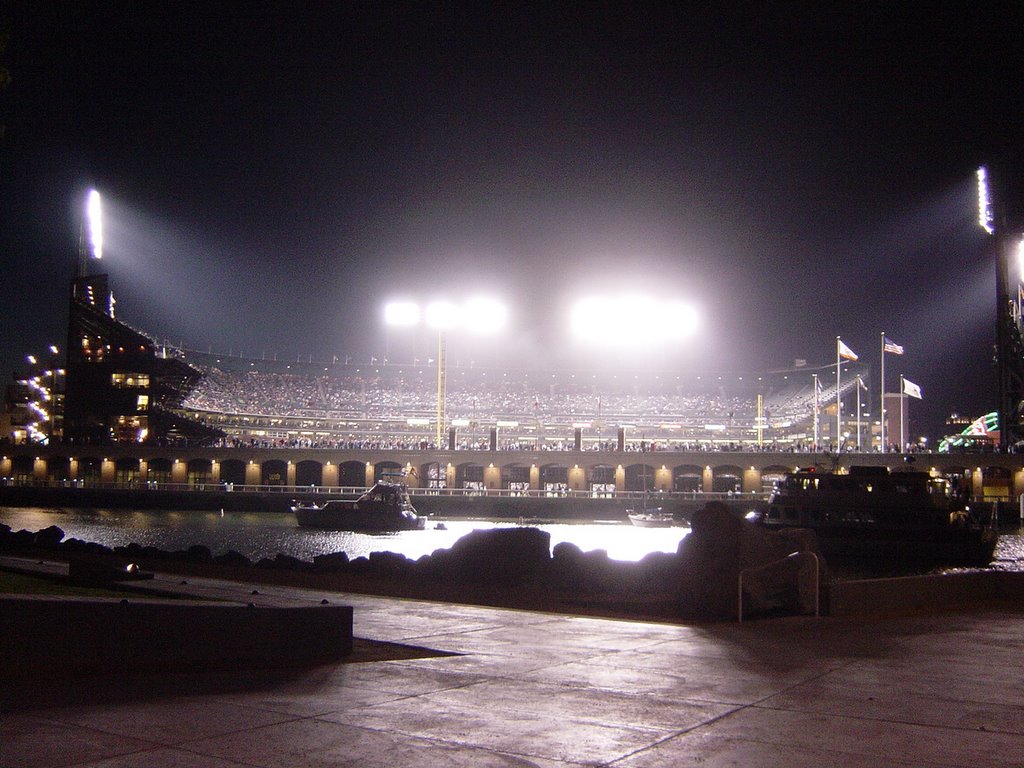
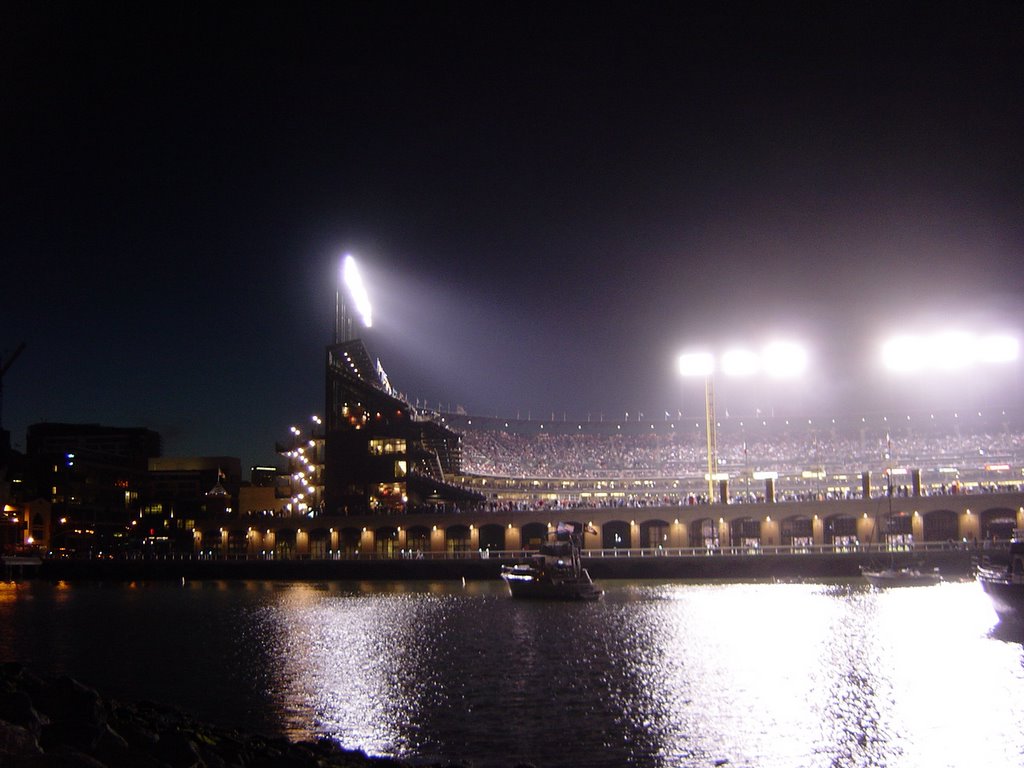
Pac Bell Park photo series:
September 16, 6:55-6:56 p.m.

A lot of the Tibetan Book of Natural Liberation Through Understanding in the Between has been resonating. It certainly hasn't been resonating negatively as being wrong or offensive to my pre-existing/primordial belief. You can't make shit like that up – that's one of the bases for my accepting it.

I've had my own imaginings on death. Once while in a Summer class on the top floor of Mudd Library at Oberlin, I thought it would be funny if someone walked in and interrupted, saying, "I'm sorry, something went terribly wrong with the library ventilation system, and you all died. You're dead." Dying without even knowing it, but then it soon becomes clear that we've left our bodies and the living can't see us anymore. Yea, that was my sense of humor way back then.

I still like to think that we remain in a non-corporeal form for a little while, but stripped of human judgments, feelings, and sentimentality, and in that stage we can touch upon or reflect upon our lives in a way that closes things out. We can "visit" the people who meant something to us, wherever they are, just see, touch, and go.

I also to some degree also believe in the "life flashing before our eyes" and the dark tunnel and the light, because so many near-death accounts include those.

But then I don't think there is one all-encompassing death experience either. I do believe in ghosthood for individuals who have received such psychic trauma that they can't move beyond this lifetime (i.e., they never make it to the clear-light reality between) until something resolves. Those individuals also have not accumulated enough bad karma to descend to the so-called "lower realms" of existence, which I vaguely accept.

I don't believe in karma as a moral system, or karma as punitive for bad action, thought, and words, or rewarding to good action, thought, and words. It is simply the law of cause and effect, and the "good" and "bad" effect for a given karma-creating causal event is interpretive. Ordinary humans can't understand karma enough to control it consciously or intentionally, but must be mindful of it, those who believe in it at least. There are different kinds or wheels of karma, too.

There are different kinds of death, too. I think infant deaths, violent deaths, suicides, and natural deaths are all qualitatively different, and those qualities all have some effect on navigating the between, but none of those qualities are dispositive as to the success or failure of navigating it to liberation.

Plugging in my own beliefs with this text on the betweens and vice versa.

Tuesday, September 16, 2003

I'm not sure I agree with Robert Thurman when he writes that it is clear that the Tibetan Book of Natural Liberation "deplores suicide". From what I'm gathering, death is death. Once you enter the processes of the death betweens, how you got there doesn't seem to be much of an issue.

How one navigates the betweens is affected by karma, spiritual guidance, spiritual aptitude, knowledge and practice, and other things. How one died may affect karma (and probably does more often than not), but how suicide affects one's karma may or may not affect one's navigation of the betweens. I'm not reading any indication that how dying from suicide is "deplored" in the between.

And we all know what a conundrum karma is whenever I start talking about it.

The only indication I can find that suicide is frowned upon is through the fact that one presumably does not have a guide or someone to recite to them when they die. And that's not true because if it's medically assisted, you can have someone recite to you. Also there are plenty of ways people die that don't allow for a guide or recitation.

Sorry, Donnie Darko, we do die alone. You can have someone recite to you and try to guide you through the betweens, but it's up to you and your karma to determine whether you can be liberated or you continue in the cycle of life and death. Liberation is hardly a sure thing. And the book itself states that you don't need a guide or a recitation if you can prepare yourself well enough to navigate the between, whatever that means.

Monday, September 15, 2003

For some reason I always thought of 'eternity' as time ever-lasting; for the rest of time, where ongoing time was part of the equation. Now I'm thinking that the only way that makes sense is by defining 'eternity' as the end of time, or the state where time no longer exists.

That makes me think of the concept in physics related to time travel, where the faster you go, closer to the speed of light, the slower time runs. It is also stated that nothing except light can travel at the speed of light. Hmph, how convenient. But theoretically, if something gets asymptotically closer to the speed of light, does it get correspondently slower in time? Maybe time stops altogether at the speed of light, i.e., eternity?

But I also already carry around the wacky notion that God=the speed of light.
It is clear that the Book of Natural Liberation (the so-called "Tibetan Book of the Dead") deplores suicide unless the person has already attained liberation, or is confident he or she can do so in the between. - Robert Thurman translation, p. 90 (his own text).

If I'm not confident, I don't know what is.

I like Robert Thurman's full translation of the title, The Great Book of Natural Liberation Through Understanding in the Between. I like the translation of the "between" for the word "bardo" referring to the states we go through in life and death, although in the context of the book, the various "betweens" refer to the death states between dying and being re-born. Although maybe "bardo" specifically refers to those betweens, I don't know. Get off my back, do I look Tibetan?

Anyway, I like it because referring to these states as "betweens" helps envision the life-cycle as a circle where one is always between other states. It's a continuous progression with where you are coming from and where you are going all being connected.

Sunday, September 14, 2003


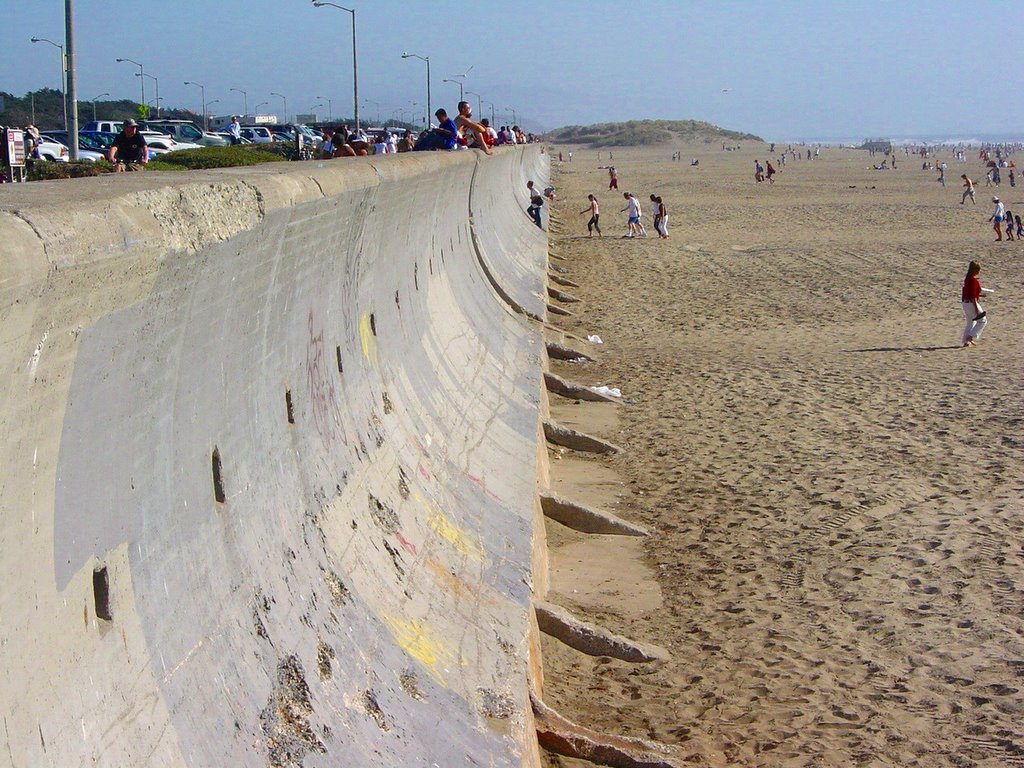
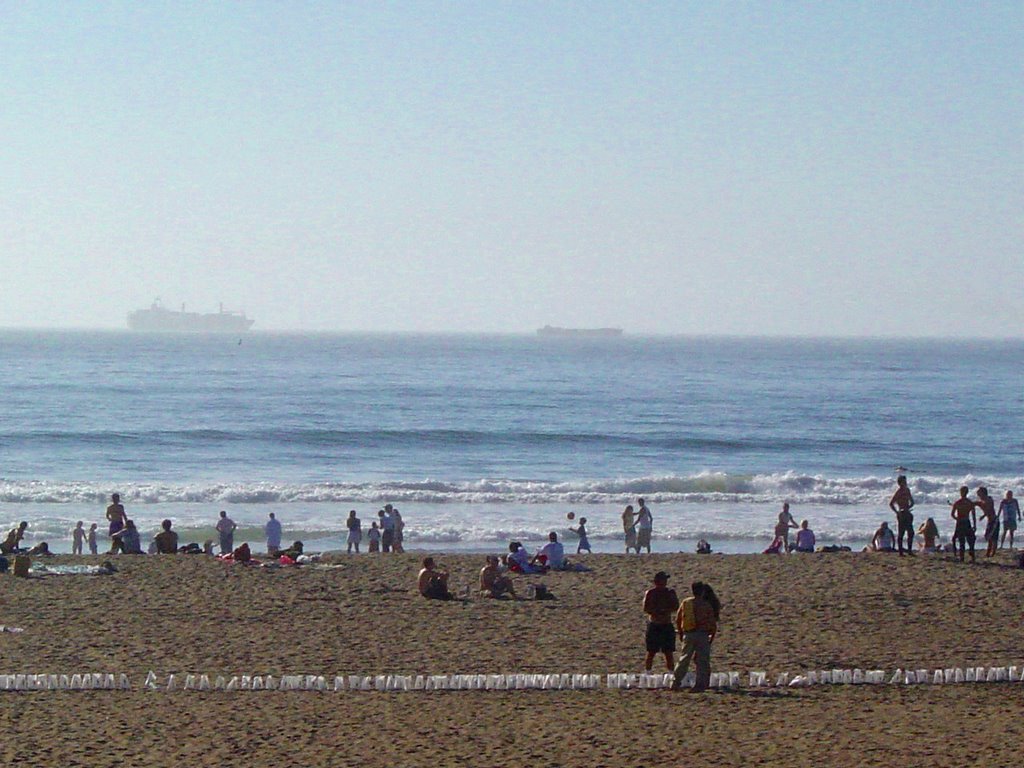
Ocean Beach.


September 11 commemoration, I think.

Saturday, September 13, 2003

I'm not suggesting anything, but I'm finding that the so-called "Tibetan Book of the Dead" is the most important book for me to be reading at this point! Something just seems very natural about my reading it now, even though I've known about it for a long time. Death is a language and reality that I understand and relate to.

I really don't obsess about death or have a fixation on it. That our lives end in death has always had a profound impact on how I view life and the life-cycle. Death as the end of our lives didn't make much sense. So I think it was pretty early in my formulation of reality and existence that life isn't as finite or concrete as we tend to live it. It's one side of the coin, the trunk of the elephant (or the leg, or the body, or the tail), it's a cross-section under a microscope, it's one station on the radio dial.

I think perhaps my current lifetime is a meditation on the role of death in existence and the life-cycle, and the concept of self in death. That's why I'm drawn so strongly to suicide. Out of all the ways to die, how many focus so intently on the self?

It kinda fits – the Tibetan Book of the Dead, in brief, deals with the process upon dying and the Buddhist cosmology it fits in (although the techniques involved can be applied to any belief system), but it doesn't touch on getting to that point of dying. Much of my life has involved getting to that point.


Downtown San Francisco

Friday, September 12, 2003

Off:
It was one of those days where every decision I made felt wrong. Patience and tolerance levels were low, while anger, hate, and presumably fear were high. Random people were annoying the hell out of me right and left. I think this was largely the way I had been living my life. Today felt like an exception.

I felt impermeable today. Life and the world not entering into me, and me not getting out into it, being in it, being a part of it. All that I've learned and felt activated lately wasn't there. I wasn't giving anything to the world, and the world wasn't giving anything to me. Just a walking impermeable fleshbag of ego. It's good that today felt like the exception.

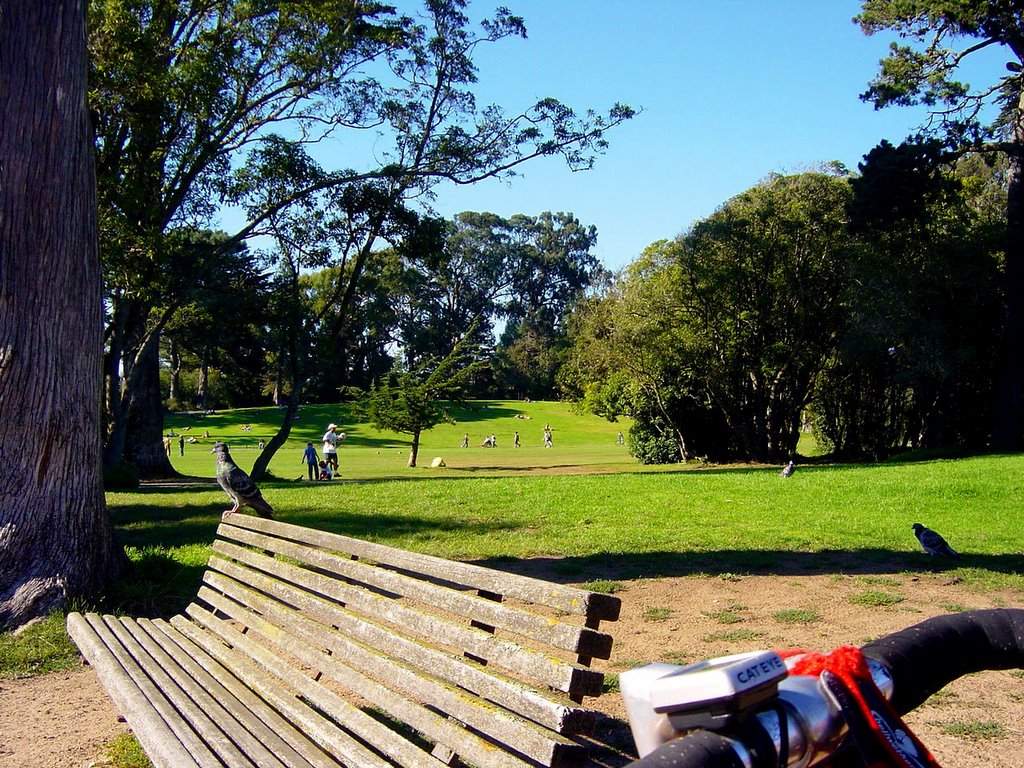
I ended up in Golden Gate Park and did some reading in the so-called "Tibetan Book of the Dead". I re-read parts that I read in the morning and couldn't penetrate, and that's when the impermeability started melting away. I got the pages with a vengeance.


Reading with the pigeons in Golden Gate Park.

Thursday, September 11, 2003

Off today. Woke up and was just "off". Even after a whole pot of coffee. Maybe it should be a "break" day. Every week should allow one break day, break the routine and not require anything, but I'll probably go out and read somewhere, seeing as today and tomorrow are supposed to be Bay Area versions of a heat wave. I already spent the entire morning watching anime.

Avoiding today's media smarm. Sure, we should remember, but all this media tugging at my heart-strings is inherently more cynical than anything I could artificially conjure, even if I tried. Stick to the facts and "remember" how the Bush Administration has cheapened the lives lost with its war-mongering and corporate profiteering. I recorded a three hour American Experience documentary a few days ago, chronicling the entire life cycle of the World Trade Center towers. I still flinched.

My problem with American Buddhism, even imported, is its need to explain or express things in dichotomies, mostly of positive and negative, as if Buddhism's only contribution to America is to help some suburban blonde office worker distinguish between what feels good or bad. I'm sure I have plenty to learn from American Buddhism.

But for now, it's the so-called Tibetan Book of the Dead. Finally, a flying carpet that I can jump on and ride.

Tuesday, September 09, 2003

I miss the feel of someone wrapping their arms around me from behind. I miss the feel of my face an inch away from a loved one's face. I miss running my hands through the hair at the back of her neck. I don't want it, I just miss it.

one year ago


I call this "rage, rage against the building of the new Asian Art Museum in Golden Gate Park". If you can think of a better title, let me know.

Monday, September 08, 2003

Inundating myself with Buddhism these days, I have to remember that these things, truths and beliefs, must be found and not fed by blind faith. In general, Buddhism as a language comes through the airwaves with the clearest reception, but there are other things I understand better when spoken in Islam or Judaism, with Native American and other indigenous cosmology and spiritual belief contributing not a little. There has even been affirmation from Christianity once I get past the historical, political, superior-moralistic, imperialistic obscurations.

Truths and beliefs must resonate, and I don't find all things in Buddhism resonating. It's not that I think those things are wrong or that I disagree with them, but to be added to my pantheon of personal truths, to affect how I think and live, it must resonate. And not resonating now, doesn't mean it won't resonate sometime in the future or in a future life. It may well be, and this part of Buddhism resonates lightly, that past karmic obscurations are preventing these things from resonating.

In the book Dharma that Every Buddhist Must Follow, the Buddhist cosmology presented does not resonate, nor does the presented heirarchy of the cosmos, and I find certain contradictions and inconsistencies in what is presented. And in general, the book is quite a downer, focusing on innumerable negatives, which ring counter-productive in my ear (NB: the book was given to me by my cousin, and the group she got it from she later acknowledged was a cult, that her future husband got her out of). Although it's not as annoying as a lot of Western Buddhism which seems to focus on the exact la-la opposite, peace, inner tranquility, bliss and happiness, bunnies and rainbows.

In general, I'm allergic to religious constructions speaking for "all of humankind". Even Buddhism speaks of saving all humankind, that bodhisattvas will not enter Nirvana until Kurt asks them to all humanity can enter at once, due to their unlimited compassion. All of that goes against my fundamental resonant belief that the belief system of any given person you meet on the street must be respected. You don't smack them in the face with a trout because they belief this or that, or don't believe this or that.


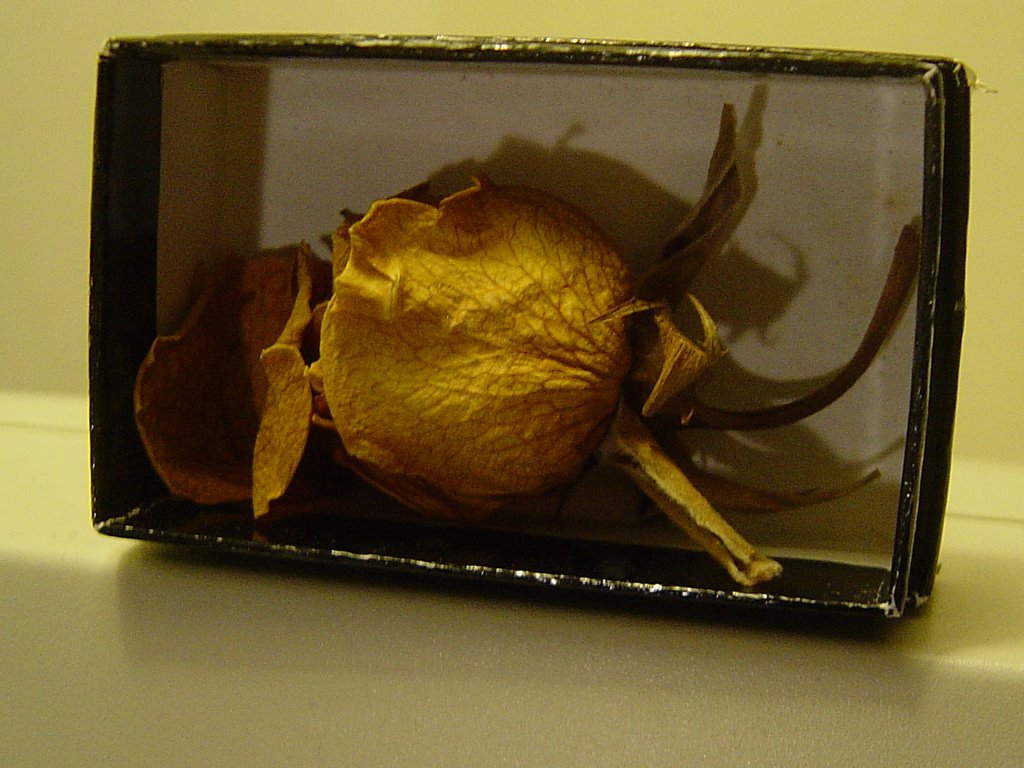
A rose Luyen gave me for my birthday in 1992. A box in which Diem gave me a jade Buddha necklace.

Sunday, September 07, 2003


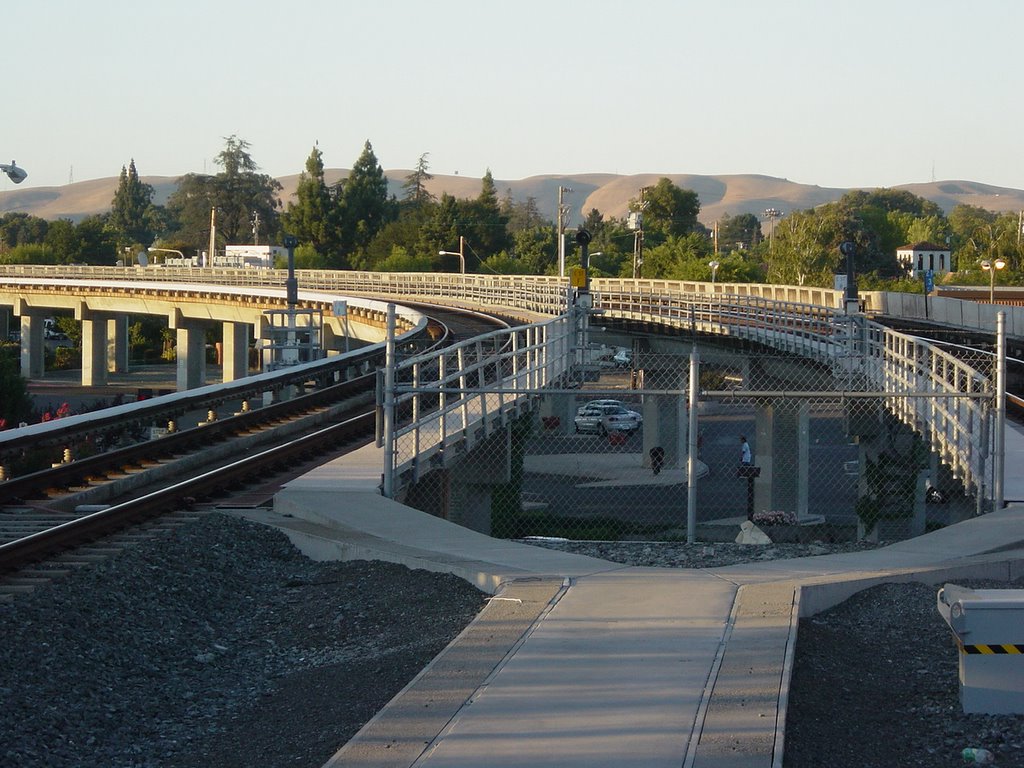
BART Station, East Bay. Post East Bay Ride.

Saturday, September 06, 2003

The story so far: 

I had this fantasy: <fantasy> that there was a time when human conscience, the human collective unconscious, spirituality, was a cloud. Amorphous, substanceless, particulate. It was like the cloud of gas that formed our solar system, which then coalesced and spun and started to heat up and burn; spinning, orbiting clumps which avoided becoming part of the sun became planets. It was like the universe after the Big Bang, just extremely hot gas which would in time through the processes of physics, astrophysics, general relativity and quantum mechanics would become the universe as we see today. 

On this planet, Earth, God created life. God IS life. God is not a conscious entity. God is everything that is and isn't through multiple veils and dimensions that no thing in the universe can conceive. God, on this planet, took a form of the primordial human collective unconscious. It was just a cloud, and remained a cloud through billions of years of evolution of life on this planet, but as lifeforms became more animate, the cloud started to form clumps, and it was in the earliest form of humans, with the spark of conscience and primitive analytical and abstract understanding of the world, that the human collective unconscious came into concrete, separate existences. 

The human collective unconscious is in us all, it is God, it is what makes us all the same despite millennia of evolutionary difference and social, cultural, and political distinction. What is in me is also in you on a sublime level, we as humans share a cross-section of consciousness. If you believe in reincarnation, the cycle of birth and death, the law of cause and effect (karma), then Tibetan Buddhism suggests it is fact that every living being at one point was your family member. Start with one average family, and consider the possibility that time is not linear, through generations and generations through history past and future hence, at any given moment in history, every living being at one point was or "will be" your family member. 

That's too heavy for me. I can't conceive it and have no direct feeling or experience or insight into it, but I can't refute it and have no reason to doubt it, and at worst it's a good sentiment, it's a good thing to work with. And the value of "family member" to me in this life is only nominal, so I'm sure I'm missing the profundity anyway. Bringing it down a notch, it's all good and fine if every living being should be treated as one would treat a family member, but families tend not to get along. 

But in the vast amorphous pool of humanity out there who should be treated as family members, there are clumps. People who resonate – friends, loves, companions, teachers, mentors, guides, etc. The people that gravitate towards each other, people who have a magnetic bond, those are the ones that have met each other in multiple lifetimes with multiple relationships between them. Maybe there were promises made to always look for each other in subsequent lifetimes. If time is not linear, it's not always the easiest thing to be reborn in the same historic period, but when they are, they will somehow find each other, as parent-child, siblings, friends, lovers, mentors, etc., etc. 

In 2017, I will be 48. </fantasy>

Northern Exposure Quote of the Day: "It's just a theory." - Dr. Sigmund Freud.

Friday, September 05, 2003

OK, I admit it, I have hate and anger issues. They don't get expressed in a direct confrontational manner, so I don't think anyone would say that I have a temper, like my father did and at least one of my brothers does. But what I mentioned before about people annoying me and getting on my nerves, and responding to negativity with negativity. All those related behaviors are rooted in hate and anger, I shouldn't wonder.

I grew up hating and being angry at my parents. Eventually I stopped hating and being angry at them when I realized they had no more control over me, but I was still left with the feelings or issues of hate and anger. Nowhere to channel it. Nothing to hate and be angry at. Just internalize it.

I hate to admit this since I just saw "Donnie Darko", but fear is also in that equation (remember? the "fear-love" spectrum?). The hate and anger breeds fear. What am I afraid of? Probably a lot of things. And to cope with the fear, I'm publicly sarcastic, cynical, smug, and indifferent.

These things need to be focused on and grappled with. I want to get back to a more innocent and vulnerable mind. Absorb the negativity, look at it directly in the face when it's thrown at me, and don't respond or react. Process it and let it go.
The path is a fragile balanced thing. Progress must be humble without being discouraging, and it must be encouraging while not getting proud.

Wednesday, September 03, 2003

I went to Beale St. tonight, but I think I'm going to try to stop going. The drinking is not a big deal. My constant drinking has fallen off lately, so I consider the occasional round of beers with chums harmless. I also decided to stop buying alcohol, so although I'm allowing myself to finish off what I have in my apartment, I'm not replenishing my stock. The constant drinking while at home is over.

I still have some top shelf stuff that I'll sip through (you don't shoot the good stuff), and a bunch of liqueurs and a single bottle of wine. People rarely notice any difference between me drunk and not drunk. The key indicator has been smell, and not behavior.

And quite honestly, I haven't noticed much difference either, except that I spend a lot of time reading these days, and I can't concentrate on reading when I'm drinking. Before long, no one will even know how much I used to drink. Fortunately, I've never thought of being "alcoholic" as part of my identity, so no loss there if nobody acknowledges the loss.

But I also want to stop going to Beale St. because I can't seem to stop letting people annoy the hell out of me. It's a character flaw. It's not everyone, hell, it's not even a majority, but it's just one or two people who might momentarily bring out a part of me that I don't like. I'm still negative at the core, and when negativity is thrown at me, I resonate negative.

Aside from not solving anything, abandoning the Beale St. crowd is problematic because they are the only social group I have left!


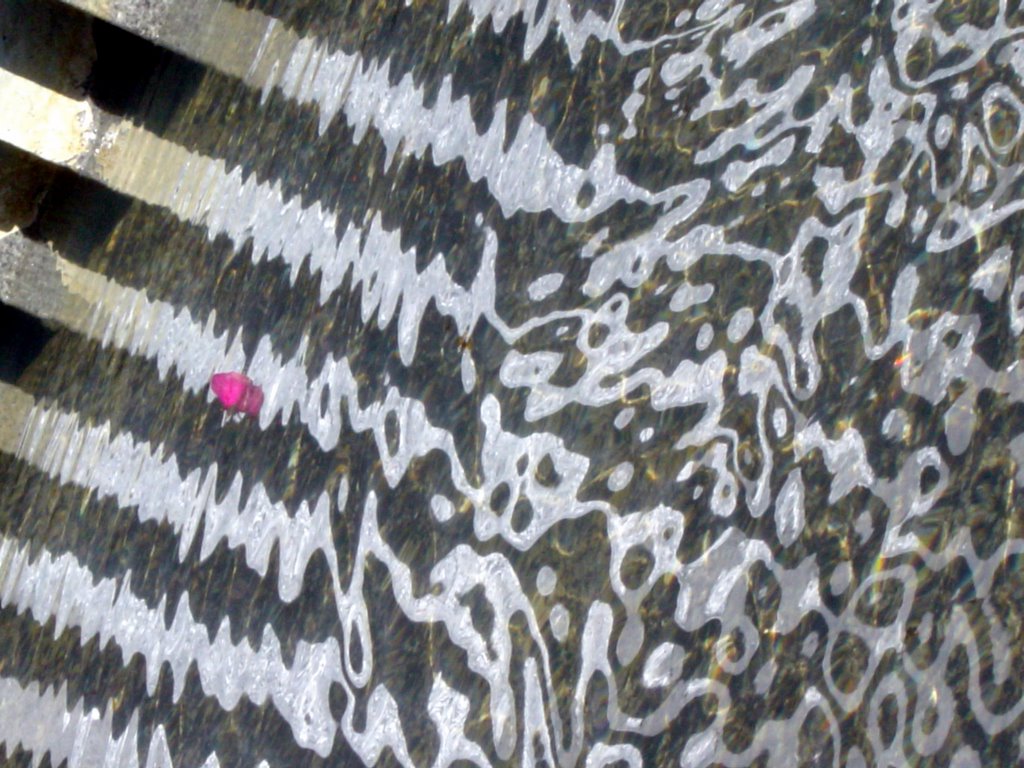
Reflections in the pool at Yerba Buena Gardens.

Tuesday, September 02, 2003

So what's the story so far? I seem to have lost track and various bits and shards of narrative are scattered and flung about. I spend a lot of time looking back, years in huge swaths and chunks of meaninglessness. Most of it remnant, little of it extant. Astronomer aiming an ever more powerful telescope into the universe's past, what's the story so far? I'm sure the universe wouldn't want to change a thing, why should I?

Childhood, high school, college, and San Francisco Bay Area; my past in chunks, monolithic eras. Perusing the record, it's hard to find what was meaningful in any of it. And by meaningful, I mean lasting. Meaningful "moments" abounded, but not a whole lot has lasted; not a whole lot has been strong enough to last.

As for the future, I won't go back to the status quo. If the future treads out the same meaninglessness, it's really not worth it. The only thing that has lasted throughout my past has been my ideals, my personal search for the kind of person I want to be; my search for just a scratch of clarity; being true to my nature . . . and yeeks, what a seriously crap job I've been doing.

So I don't know what to say about the "future". I really, really, really don't know what I'm going to do and I'm not going to think about it. It's not worth getting wound up about it or getting people wound up about it. I'm vaguely thinking that I'm waiting to hear from the monastics, but I'm really not thinking about that concretely or seriously.

Truth to tell, these past few weeks I've been keeping disciplined, reading a lot, studying, sitting regularly, trying to keep my mind still and as singularly focused in the moment as possible. But I'm split on the monastery thing. On one hand, maybe this is simply the right time and I haven't been ready until now, and I'm ready now. Living a material life has nothing left to offer, and I needed to exhaust the options before getting to this point. And at this point, a structured environment is the next step.

On the other hand, what I've been concentrating on these past weeks, why haven't I been concentrating on it for the past ten years?! How sincere can I be when I only buckle down when I'm at my wit's end, story's end; only when I've exhausted my distractions and plot twists? If I can buckle down like this so quickly and easily, it means I could have done so for quite some time. A lot of what I'm reading and encountering isn't new, it's just been neglected, I've been lazy; I've had the key, just too lazy to put it to use. So part of me feels I don't deserve it.

But then there's Christian in Pilgrim's Progress, who had his moment when he acquired his burden and had to pursue the spiritual path from that moment on. He acquired his burden when he read that book (the Bible) and felt compelled right away. Is that immediacy the measure of sincerity for recognizing the burden? I don't think so. I think a person can be exposed to the path long before you recognize the burden of life and existence that compels you to follow the path. Like the birds in The Conference of the Birds, each bird is an excuse for not following the path, needing to be shed before embarking on the journey.

I need to keep putting another foot forward.
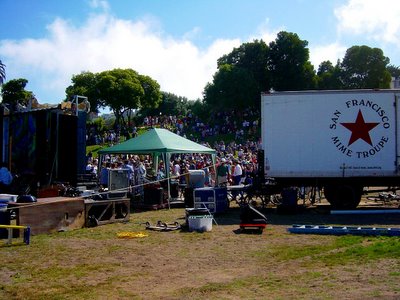

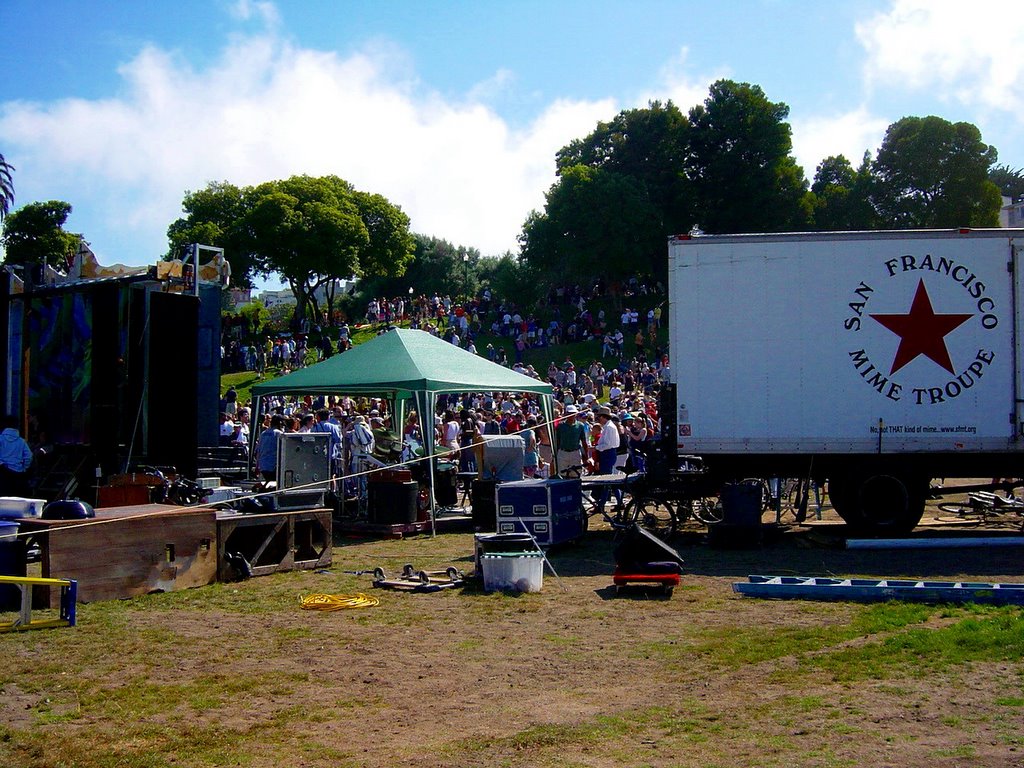
San Francisco Mime Troupe in Dolores Park on a particularly warm day (for San Francisco, that is).

Sunday, August 31, 2003


August 31, 2003; 2:50 P.M. - Doing the Sunol Grade ride in the East Bay.


August 31, 2003; 2:51 P.M. - It had a caboose! You can see people in the windows if you click on it for the larger version.

Saturday, August 30, 2003

I had a less literal dream this morning. In fact, it was pure transparent metaphor so I won't even bother describing it. The overall metaphor was the journey that can't get started due to trivial, petty distractions. The dream journey was to drive with my parents from New Jersey to my uncle's place in Ohio in separate vehicles. I think I was driving a big u-haul truck. My parents never make an appearance in this dream.

One of the distractions was a woman who was asking me a question and then blowing me off when I was answering. Another distraction was Katie, the black hole of a friend who is now attending Golden Gate University law school, and yes, this part of the dream was set there.

There was a futility metaphor as I went searching classroom to classroom for the professor/parent of a friend who I was supposed to call upon arriving in Ohio. The "friend" was no one I know in real life, and I didn't have a name or face for the professor/parent, I was just supposed to recognize her.

Then there was the disconnected/abandonment metaphor as I gave up on trying to find that professor/parent, and was trying to figure out how to get in touch with my parents who were waiting for me at my uncle's place on this end of the journey, and who may have left already, in which case I would have been screwed. I realized I didn't have their phone number, and also didn't know my brothers' phone numbers either, so I was trying to figure out who I could call to get the phone number.

The metaphor of the beginning of the journey being the same as the end of the journey is more subtle. But not as subtle as the journey in The Conference of the Birds where the end of the journey turns out to be the travellers on the journey. Oh come on, I didn't give anything away. Like you were about to go read a book that is filled to the brim with metaphor after metaphor why all your excuses for not undertaking the spiritual path are invalid.

Other assorted facts about the dream: That uncle, who now lives in New Jersey, as do my parents, used to live in Ohio. Even though we were leaving from New Jersey, it was actually San Francisco with both my uncle's place on this end of the journey and Golden Gate University located on or near what looked like the Embarcadero.

Friday, August 29, 2003


August 29, 2003; 5:58 P.M. - A rare photo taken during Critical Mass with no bikes in it.